Debt consolidation loan vs. balance transfer: compare the real cost
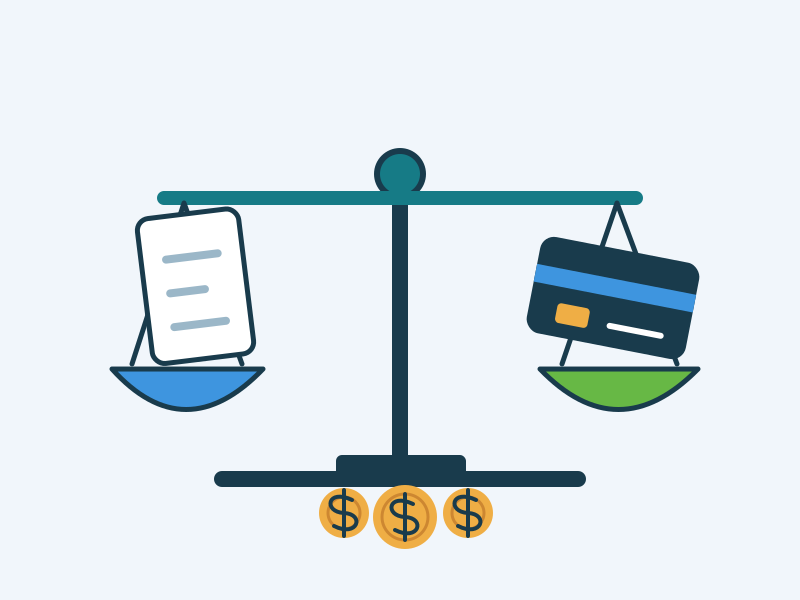
Short answer: A debt consolidation loan replaces debts with a loan repayment schedule. A balance transfer moves eligible debt to a credit card, potentially at a temporary promotional rate. Compare fees, the payoff deadline, required payment and total cost using actual offers. The lower advertised rate is not enough to choose.
Partner sites to compare



How the options differ
| Question | Consolidation loan | Balance transfer |
|---|---|---|
| Repayment | Agreed term and schedule; check whether the rate is fixed | Card minimum payments plus a plan to finish before the promotion ends |
| Costs | APR, origination fee, total repayment and payoff charges | Transfer fee, promotional period, later rate and applicable card fees |
| Usable amount | Approved principal minus any deducted fee | Available limit and issuer transfer rules |
| Eligible debts | Check permitted uses and creditors that can be paid | Check eligible balances and transfers between related issuers |
The CFPB’s consolidation guidance explains that combining debts does not erase them. A smaller monthly loan payment may reflect a longer term and higher total cost. A transfer’s introductory rate expires, and a transfer fee may apply. Read the written terms for either option.
Worked comparison: $6,000 of card debt
These are invented terms for calculation, not advertised products. Assume no new spending, late payments or other fees, and no interest on the transferred amount during the stated promotion.
Option A: transfer. Move $6,000 with a 3% fee and 0% promotional interest for 18 months. The fee is $180. If added to the balance, the amount to repay is $6,180. Divide by 18 to get a monthly target of about $343.33, with a small final rounding adjustment.
Option B: loan. Borrow $6,000 at a fixed 12% annual interest rate over 24 months with no fees. At 1% monthly interest and equal end-of-month payments, the payment is approximately $282.44. Total repayment is $6,778.58, including $778.58 of interest, using unrounded calculations.
| Illustration | Transfer | Loan |
|---|---|---|
| Planned payment | About $343.33 | About $282.44 |
| Payoff time | 18 months | 24 months |
| Financing cost | $180 fee | $778.58 interest |
| Total paid | $6,180 | $6,778.58 |
Option A costs about $598.58 less here but requires about $60.89 more monthly and full payoff within the promotion. Option B gives six additional months and a smaller payment at higher total cost. Neither helps if its payment is unaffordable.
If your budget is only $300 a month
At $300 per month, you would repay $5,400 over 18 months on the hypothetical transfer, leaving $780 when the promotion ends. If the remaining balance then had a 24% annual rate calculated at 2% monthly, one month’s interest on $780 would be $15.60 before that month’s payment. The balance does not get a fresh interest-free period.
This illustrates an unfinished balance, not the issuer’s billing method. Use the actual expiration date, later APR, allocation and minimum-payment rules. A statement’s minimum may be below what is needed to finish during the promotion. Confirm the available limit covers the transfer and any fee charged to the account.
How fees change the result
If a loan deducts an origination fee, $6,000 approved may not send enough money to clear $6,000 of debt. Check net proceeds. If you borrow more to cover a deduction, recalculate payments and total cost on the larger principal. Our origination fee guide explains cash received versus amount owed.
Keep payoff separate from new spending
The CFPB warns that new purchases may accrue interest while a promotional transfer balance remains outstanding. Purchase and transfer terms can differ. Consider keeping new spending separate, and continue old-account payments until the transfer or creditor payment is confirmed.
Write down what prevents paid-off accounts from accumulating fresh balances. Otherwise the new simplified payment can sit alongside new card debt. Check old statements for any amount still due, and keep confirmation that money reached each creditor.
When to consider another route
If neither payment fits, compare repayment on existing accounts and ask creditors about assistance before adding debt. The CFPB distinguishes nonprofit counseling from debt settlement. Settlement is a different service from a consolidation loan and can carry significant risks. Ask what a service does before paying or following instructions to stop payments.
Common questions
Is a 0% transfer always cheaper?
No. Fees, the balance after the promotion and your ability to follow the plan determine cost. Recalculate using the offer.
Can either option pay every lender or card?
Restrictions vary. Check permitted loan uses and issuer transfer restrictions before relying on it to repay an account.
Does consolidation improve credit automatically?
No. Applications, new accounts, balances and payment behavior affect your credit file. The product label promises no score improvement.
Compare personal loan options and card terms separately. Use prequalification where expressly offered, then compare final disclosures. Finpanda’s advertising partners are not presented as verified balance-transfer providers.
Sources and how to use this guide
- CFPB: consolidating credit card debt
- CFPB: purchases after a balance transfer
- CFPB: credit counseling and debt settlement
Sources checked September 28, 2026. Finpanda provides general comparison information and does not make lending decisions. Examples are calculations using stated assumptions, not live offers. A provider’s written agreement controls. Advertising placements may earn Finpanda a commission and do not determine the explanation or calculations above.
Debt consolidation loan vs. balance transfer: compare the real cost
Short answer: A debt consolidation loan replaces debts with a loan repayment schedule. A balance transfer moves eligible debt to a credit card, potentially at a temporary promotion...
Read more
Can you pay off a personal loan early? Costs and a payoff example
Short answer: You can often pay off a personal loan early, but check the agreement for prepayment charges and request a dated payoff quote. On an interest-bearing balance, shorteni...
Read more